Temperate basses
Spotted seabass
Dicentrarchus punctatus
The seabass of the Atlantic surf, spotted for life. Smaller than its cousin, and far more common on the Moroccan Atlantic.
Temperate basses
Dicentrarchus punctatus
The seabass of the Atlantic surf, spotted for life. Smaller than its cousin, and far more common on the Moroccan Atlantic.
The legal size is set by order no. 1154-88 as amended — below it, fishing, transporting, buying or selling the species is prohibited. See the full table.
What the legal size does not tell you
The legal size comes from the 1988 order, written for commercial fishing. The maturity sizes come from scientific studies, each carried out in one particular area: they give an order of magnitude, not a rule.
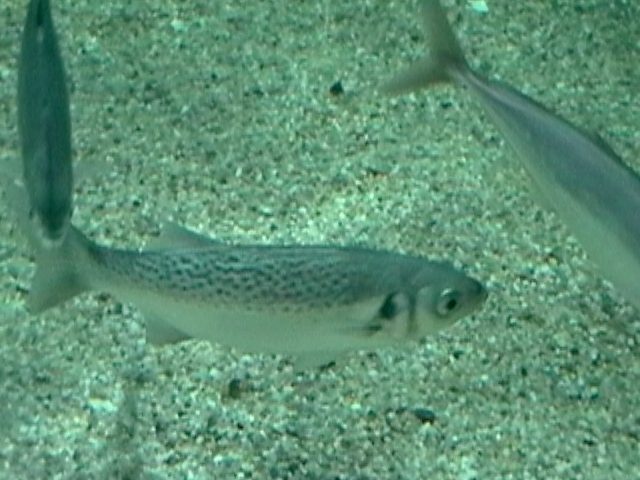
A seabass in every proportion — long, silver, two separate dorsals of equal size, a big mouth — that keeps its scattered small black spots on the back and flanks into adulthood, and carries a sharp dark spot on the gill cover. The spots are irregular, never in rows, and denser above the lateral line.
At distance it is a silver bass in the surf. The spots are visible from a couple of metres in clear water and vanish in murk, so the two species are told apart only close up: a plain-flanked adult is a European seabass, a spotted one this species.
It runs smaller: a 50 cm spotted bass is a very good one.
Surf beaches, river mouths, lagoon channels and the white water over shallow rock and sand. It is even more a fish of the shallow, turbid, moving water than the European seabass, and it tolerates warmer water, which is why it replaces its cousin southward.
It feeds on the small fish, shrimps and crabs that the surf turns over, often in water less than three metres deep.
Schools of small fish are common; big fish are alone or in small groups.
The Atlantic, from Tangier to Dakhla, and common on every surf beach and river mouth of that coast: the Moroccan Atlantic bass a spearo meets is more often this species than the European one. Present but scarce in the Mediterranean.
Its biology is poorly studied everywhere. The maturity figure is a best reading of the few Atlantic papers and should be treated as approximate.
Late winter to spring, from roughly January to April, inshore and in estuaries. The young grow up in lagoons and river mouths.
The Moroccan legal minimum of 15 cm is well below the size at which it first spawns.
Wary but less so than the European seabass, and far more tolerant of very shallow water. It hunts in the surf in small groups, working the edge of the white water, and it comes to a still diver in murk without much hesitation.
It reacts to movement and flash more than to bubbles, and a fish that has turned away in the surf often comes back on the next wave.
The species this one is taken for, and what tells them apart.

White seabream
Diplodus sargus

Two-banded seabream
Diplodus vulgaris

Zebra seabream
Diplodus cervinus

European seabass
Dicentrarchus labrax
Apart from the legal size, which comes from the order cited under regulations, this sheet describes the general biology of the species and common practice — not measurements taken on the Moroccan coast. Spawning periods differ from one coast to the other. If you know better, put us right.
Biology FishBase — Dicentrarchus punctatus · IUCN Red List — Dicentrarchus punctatus · DORIS (FFESSM) — bar tacheté · Arrêté 1154-88 — the Moroccan minimum size table · read on 14 September 2026