Jacks
Leerfish
Lichia amia
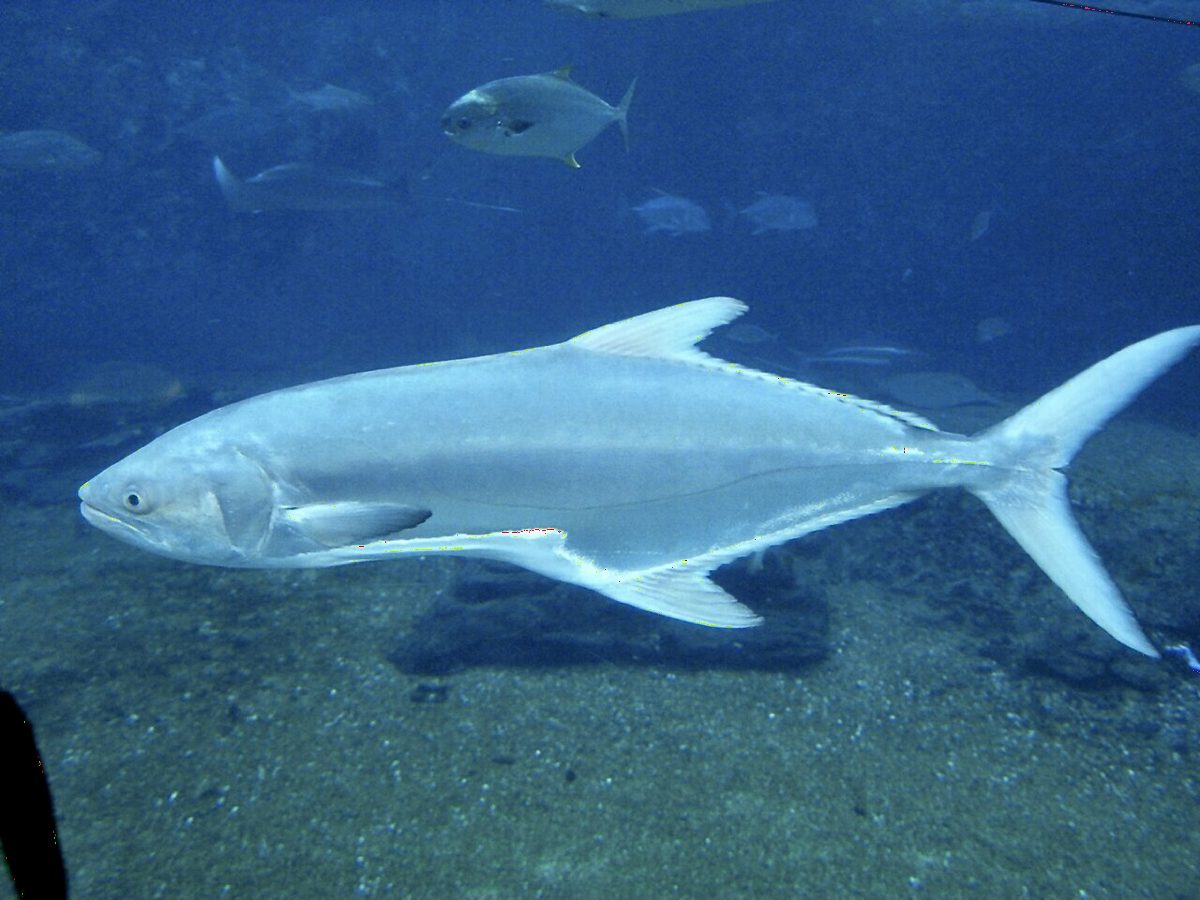
The liche. A big silver surf predator with a wavy line down its side, and one of the wariest fish on the coast.
Jacks
Lichia amia
The liche. A big silver surf predator with a wavy line down its side, and one of the wariest fish on the coast.
This species does not appear in the Moroccan marketable size table. That does not mean it is unrestricted: it means we have found no text covering it. Our gaps.
A large, deep-bodied, laterally compressed silver fish with a small head, a large mouth without visible teeth, and a lateral line that runs in a strong wave along the flank, high at the front and dipping low behind the pectoral. The second dorsal and anal are long with a raised sickle-shaped front lobe, dark-edged. The tail is deeply forked.
At distance it reads as a tall, bright silver fish that flashes as it turns, usually alone or in a pair, cruising the edge of the surf or holding just outside a breaking wave. The wavy line is the mark.
Juveniles have dark vertical blotches and school in estuaries and along beaches.
The surf zone and the water just outside it: beaches, river mouths, the white water off a point, the channel where a lagoon meets the sea. It hunts mullet and other schooling fish in shallow, moving, often turbid water, and it comes into water a diver can stand in.
It also holds over rock at 5 to 15 m near a beach, waiting for bait to move.
Warm months bring it inshore; it is scarce in winter.
Mostly the Atlantic, from Tangier to the Sahara, with the Atlantic beaches and river mouths from Larache to Agadir the classic ground. Present in the Mediterranean in summer, in smaller numbers.
No Moroccan or Mediterranean study has established its maturity with confidence; the figure here is South African, on a stock of the same species at the other end of its range.
Late spring and summer, inshore, from roughly May to August in the Mediterranean and the eastern Atlantic. The young appear in estuaries in late summer.
It grows fast in its first years, then slowly, and the large fish are old.
Wary to the point of paranoia. It sees a diver at the edge of visibility and turns away; it rarely comes in to inspect, and a fish that has seen a diver head-on does not return. Movement and flash interest it briefly and then spook it.
It hunts alone or in pairs, patrolling the same stretch of surf on a circuit and passing the same point at intervals. That circuit is the diver’s only advantage.
A hit leerfish runs very hard and very fast, straight, and then fights on the surface.
The species this one is taken for, and what tells them apart.

White seabream
Diplodus sargus

Two-banded seabream
Diplodus vulgaris

Zebra seabream
Diplodus cervinus

European seabass
Dicentrarchus labrax
Apart from the legal size, which comes from the order cited under regulations, this sheet describes the general biology of the species and common practice — not measurements taken on the Moroccan coast. Spawning periods differ from one coast to the other. If you know better, put us right.
Biology FishBase — Lichia amia · IUCN Red List — Lichia amia · DORIS (FFESSM) — liche amie · van der Elst 1993 and Kerstan 1995 — biology of L. amia off South Africa and in the Mediterranean · read on 14 September 2026