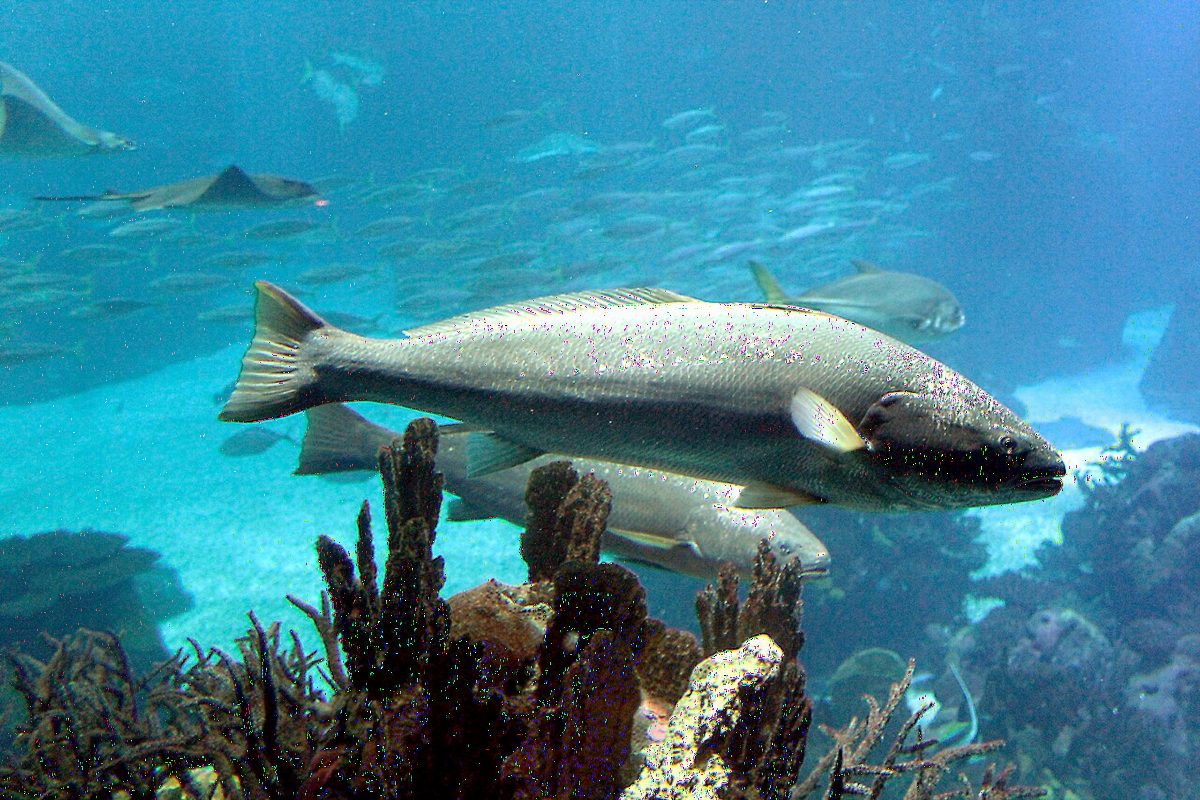
This species does not appear in the Moroccan marketable size table. That does not mean it is unrestricted: it means we have found no text covering it. Our gaps.
A long, powerful, silver fish with a bronze sheen, a large head with a big oblique mouth, a long dorsal fin with a short spiny front lobe, and a tail that is almost straight-edged. The lateral line is prominent and the inside of the mouth is yellow-orange. There are no bars, spots or stripes.
At distance it reads as a large, pale, slim shape moving slowly over sand or holding in the murk of a surf zone, often in a small group of similar-sized fish. Big ones are unmistakable by size alone: nothing else silver on this coast is this long.
In the season it drums, a deep repeated croak from the swim bladder, audible underwater at tens of metres.
Sand and mud bottoms near the coast, estuaries, surf beaches and the sandy fringes of rock. It is a fish of turbid water: river mouths, the white water off a beach, the murky edge of a bay. It also holds along deep sandy drop-offs and around wrecks on sand.
It follows bait: mullet, sardine and cephalopods, which it hunts with its ears as much as its eyes.
Young fish grow up in estuaries and lagoons. Adults move along the coast and into estuaries to spawn.
The Atlantic, above all. From Tangier to Dakhla, with the largest fish in the south: the bay of Dakhla and the coast from Boujdour to the Sahara are known for very large meagre. It is present in the Mediterranean but far scarcer.
Morocco is one of the few places where its biology has actually been studied locally, in the 1970s. The maturity figure here is Atlantic, from Mauritania to Portugal.
Spring and early summer, from April to July, in and around estuaries and river mouths, where the adults gather and drum. The sound is how spawning aggregations are found, by fishermen as well as by other meagre.
It grows fast when young and slow when old; a metre fish is a decade old and a 1.5 m fish several decades.
It moves in loose groups of similar size and hunts near the bottom in poor visibility, where it has the advantage. It is wary but not panicky: a group met in murk often holds and drifts rather than bolting, then moves off together.
It responds to sound. A diver who makes noise sends it away; one who makes none sometimes has a group drift past within a body length.
Big fish are more solitary and hold deeper, on sand at the base of rock or around a wreck.
The species this one is taken for, and what tells them apart.

White seabream
Diplodus sargus

Two-banded seabream
Diplodus vulgaris

Zebra seabream
Diplodus cervinus

European seabass
Dicentrarchus labrax
Apart from the legal size, which comes from the order cited under regulations, this sheet describes the general biology of the species and common practice — not measurements taken on the Moroccan coast. Spawning periods differ from one coast to the other. If you know better, put us right.
Biology FishBase — Argyrosomus regius · IUCN Red List — Argyrosomus regius · DORIS (FFESSM) — maigre · Quéméner 2002, IFREMER — the meagre: biology, fisheries and aquaculture · Tixerant 1974, thesis — the biology of the meagre on the Moroccan Atlantic coast · read on 14 September 2026