Groupers
Goldblotch grouper
Epinephelus costae
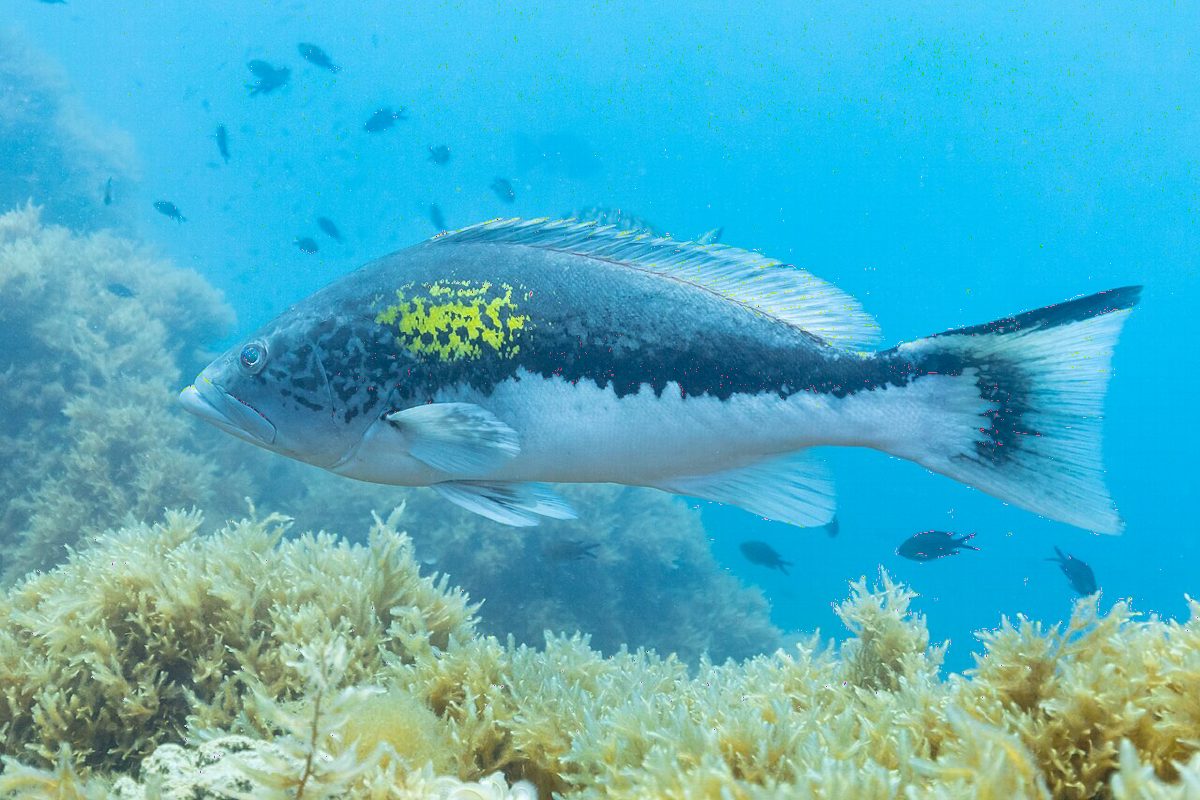
The badèche. A slimmer, paler, more mobile grouper than the dusky, and the one most Atlantic spearos actually see.
Groupers
Epinephelus costae
The badèche. A slimmer, paler, more mobile grouper than the dusky, and the one most Atlantic spearos actually see.
This species does not appear in the Moroccan marketable size table. That does not mean it is unrestricted: it means we have found no text covering it. Our gaps.
What the legal size does not tell you
The legal size comes from the 1988 order, written for commercial fishing. The maturity sizes come from scientific studies, each carried out in one particular area: they give an order of magnitude, not a rule.
A grouper with a grouper’s big head and mouth, but slimmer and more elongated than the dusky, grey-brown to pale brown with faint darker oblique lines along the flank and a paler belly. Juveniles and young adults carry a distinct golden-yellow blotch on the flank behind the pectoral, which fades on old fish. The tail is rounded and dark-edged, the dorsal long.
At distance it is a pale, elongated grouper hanging in midwater a metre or two off the rock, or moving slowly along a wall, rather than sitting in a hole. Where a dusky sits and looks, a goldblotch drifts and turns.
Big old fish are plain grey-brown and are told from a dusky by the slimmer body and the faint oblique lines.
Rocky coasts from a few metres down, with a preference for deeper walls, boulder slopes and the edges of reefs where they meet sand. It uses holes and overhangs for shelter but spends more of its time in the open than the dusky, patrolling a stretch of rock in midwater.
It hunts fish, cephalopods and crustaceans, often in small groups of two or three, and it follows a diver at a distance out of curiosity.
Juveniles live in shallower rock and move deeper with age.
Both seaboards, and common on the Atlantic rock from Tangier to the Sahara, where it far outnumbers the dusky. Present on the Mediterranean rock too.
The IUCN could not assess its status for lack of data, and there is no Moroccan study. The maturity and sex-change figures are from Tunisia and the Adriatic.
Summer, from around June to August, on the rock where it lives. Female first: fish turn male at around 60 to 70 cm, so the large individuals are the males, as with the dusky.
Growth is slow after the first years and a large goldblotch is old.
Curious and more mobile than the dusky. It comes out to a diver, holds off at a few metres, and follows him along the rock; it is warier than the dusky but far less than a seabream, and a still diver is often approached.
It does not sit tight in a hole under pressure. It moves off along the wall and comes back later.
Groups of two or three are common, and where one is seen the others are close.
The species this one is taken for, and what tells them apart.

White seabream
Diplodus sargus

Two-banded seabream
Diplodus vulgaris

Zebra seabream
Diplodus cervinus

European seabass
Dicentrarchus labrax
Apart from the legal size, which comes from the order cited under regulations, this sheet describes the general biology of the species and common practice — not measurements taken on the Moroccan coast. Spawning periods differ from one coast to the other. If you know better, put us right.
Biology FishBase — Epinephelus costae · IUCN Red List — Epinephelus costae · DORIS (FFESSM) — badèche · Bouain & Siau 1983 and Glamuzina et al. 2000 — biology of E. costae in the Gulf of Gabès and the Adriatic · read on 14 September 2026