Barracudas
Barracuda
Sphyraena viridensis
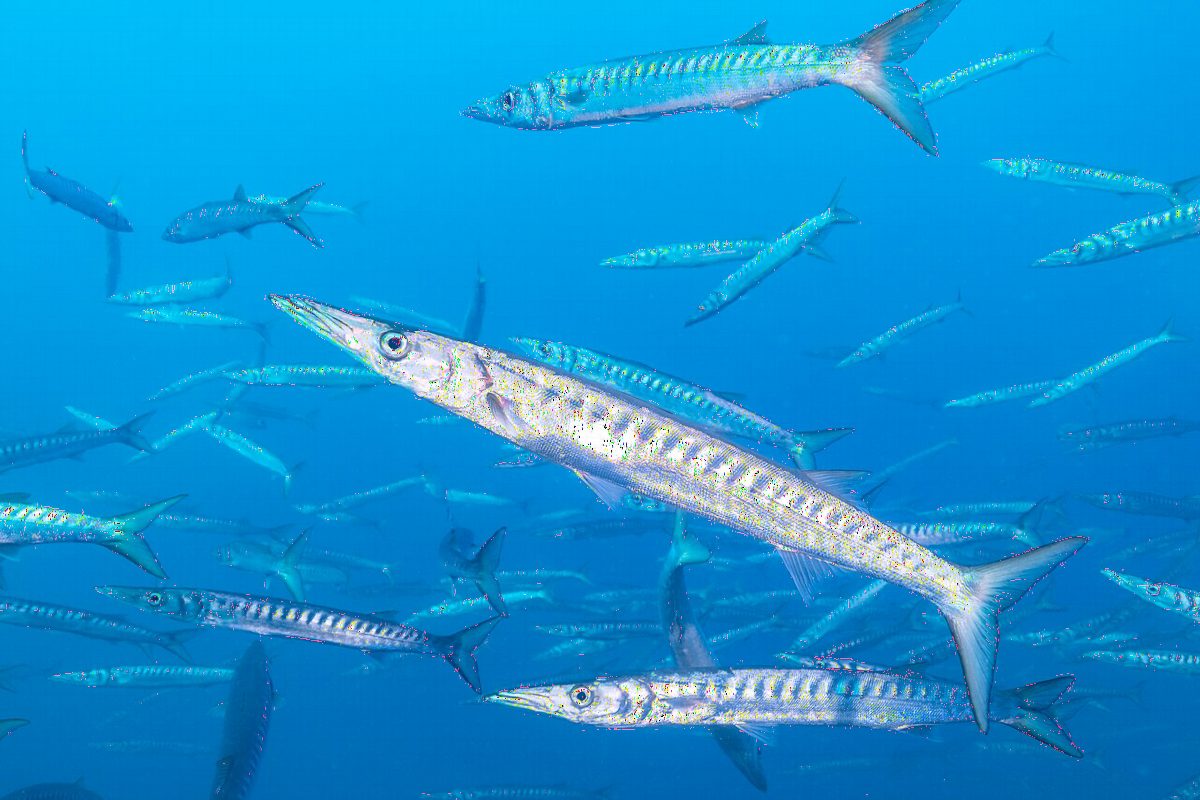
Long, silver, toothed, and curious. A school of them hanging in the blue is one of the sights of the Mediterranean summer.
Barracudas
Sphyraena viridensis
Long, silver, toothed, and curious. A school of them hanging in the blue is one of the sights of the Mediterranean summer.
This species does not appear in the Moroccan marketable size table. That does not mean it is unrestricted: it means we have found no text covering it. Our gaps.
A very long, slim, silver fish with a pointed head, a projecting lower jaw, large visible fang-like teeth, and two short dorsals set far apart. The back is dark grey-green with a series of dark bars that reach below the lateral line on the front half of the body. The tail is forked and the whole fish is built like a spear.
At distance it is a school of silver bars hanging motionless at midwater, all facing the same way, turning together. Close up the barred flank, the teeth and the yellowish inside of the mouth are the tells.
The smaller European barracuda has scales on the cheek and bars that stop at the lateral line; this one has a bare cheek and bars that cross it.
The water column over rock: points, walls, pinnacles, the outside of a reef, and the open water near them. It schools at midwater by day, often over a specific rock it returns to, and disperses to hunt at dusk.
It is a fish of clear warm water, and on the Mediterranean side it is a summer fish, arriving with the warmth and leaving in the cold.
Juveniles and small adults form the large schools; big fish are alone or in small groups, deeper.
The Mediterranean coast in summer and autumn, on every rocky point from Saïdia to Tangier; the Atlantic north to Agadir in smaller numbers, more in warm years.
The species was only separated from the European barracuda in the 1990s, so older Moroccan records do not distinguish them. The maturity figure is from the Azores, the nearest Atlantic study.
Summer, from around May to August, offshore in open water. The schools that gather on the points in early summer are pre-spawning aggregations.
Growth is fast in the first years; a metre fish is old.
Curious and unhurried. A school holds at midwater and lets a diver come close, watching; it moves off slowly and re-forms nearby rather than bolting. Big solitary fish are warier and keep more distance.
It hunts small fish with a burst of speed from a standstill, and it is attracted to flash, which is what its prey looks like.
It is not aggressive to divers. The rare bite is a mistake made at a flashing object in murky water, usually on a hand holding a shiny fish.
The species this one is taken for, and what tells them apart.

White seabream
Diplodus sargus

Two-banded seabream
Diplodus vulgaris

Zebra seabream
Diplodus cervinus

European seabass
Dicentrarchus labrax
Apart from the legal size, which comes from the order cited under regulations, this sheet describes the general biology of the species and common practice — not measurements taken on the Moroccan coast. Spawning periods differ from one coast to the other. If you know better, put us right.
Biology FishBase — Sphyraena viridensis · IUCN Red List — Sphyraena viridensis · DORIS (FFESSM) — barracuda · Barreiros et al. 2002, Journal of Fish Biology — reproduction and growth of S. viridensis in the Azores · read on 14 September 2026