Mackerels and tunas
Atlantic bonito
Sarda sarda
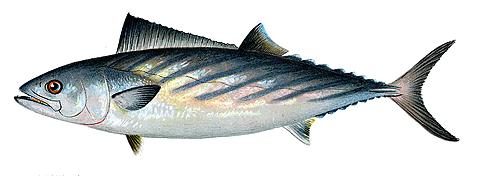
A small tuna with a striped back, fast and seasonal. The fish of the spring and autumn runs along the coast.
Mackerels and tunas
Sarda sarda
A small tuna with a striped back, fast and seasonal. The fish of the spring and autumn runs along the coast.
This species does not appear in the Moroccan marketable size table. That does not mean it is unrestricted: it means we have found no text covering it. Our gaps.
A small tuna: a compact, muscular, spindle-shaped fish with a steel-blue back crossed by five to eleven dark oblique stripes running forward and down, a silver belly, a pointed head with a big mouth of small teeth, and a row of finlets between the dorsal and the tail. The tail is a stiff crescent on a slim keeled wrist. The first dorsal is long and straight-edged.
At distance it is a tight, fast school of dark-backed fish near the surface, often boiling on bait with birds above. The oblique stripes on the back are the tell, visible from above as the school passes.
It never stops swimming.
Open coastal water: the water column off points and beaches, the outside of bays, the blue beyond a reef. It follows sardine and anchovy and it is where they are, usually near the surface, usually moving.
It comes within reach of a shore diver on points that face open water and along the edge of a current.
It is seasonal: the schools pass in spring and again in autumn, and in winter it is offshore and deep.
Both seaboards, in season. The Mediterranean points from Cap des Trois Fourches to Tangier see the spring run; the Atlantic from Tangier to Essaouira the autumn one. The south holds fish for longer.
Its biology is well studied in the Mediterranean and the Black Sea. The maturity figure is Mediterranean.
Late spring and summer, from May to July in the Mediterranean, in open water. It matures at one to two years and lives only five or six, so the stock turns over fast and the fish you meet are young.
The spring run on this coast is largely pre-spawning fish moving to the spawning ground.
Fast, schooling and curious in passing. A school comes through a point at speed, turns on a diver at midwater once, and is gone; it does not circle like an amberjack. Flash interests it.
It is not wary of a still diver, but it is never still itself. The encounter is a pass, and the shot is a lead.
A hit bonito runs hard and fast in the open, and it dies quickly on the shaft.
The species this one is taken for, and what tells them apart.

White seabream
Diplodus sargus

Two-banded seabream
Diplodus vulgaris

Zebra seabream
Diplodus cervinus

European seabass
Dicentrarchus labrax
Apart from the legal size, which comes from the order cited under regulations, this sheet describes the general biology of the species and common practice — not measurements taken on the Moroccan coast. Spawning periods differ from one coast to the other. If you know better, put us right.
Biology FishBase — Sarda sarda · IUCN Red List — Sarda sarda · DORIS (FFESSM) — bonite à dos rayé · Rey et al. 1984 and Zaboukas & Megalofonou 2007 — age, growth and reproduction of S. sarda in the Mediterranean · read on 14 September 2026