Bluefishes
Bluefish
Pomatomus saltatrix
The tassergal. A pack hunter with a mouthful of teeth, the Atlantic spearo’s bread and butter, and a species in worldwide decline.
Bluefishes
Pomatomus saltatrix
The tassergal. A pack hunter with a mouthful of teeth, the Atlantic spearo’s bread and butter, and a species in worldwide decline.
This species does not appear in the Moroccan marketable size table. That does not mean it is unrestricted: it means we have found no text covering it. Our gaps.
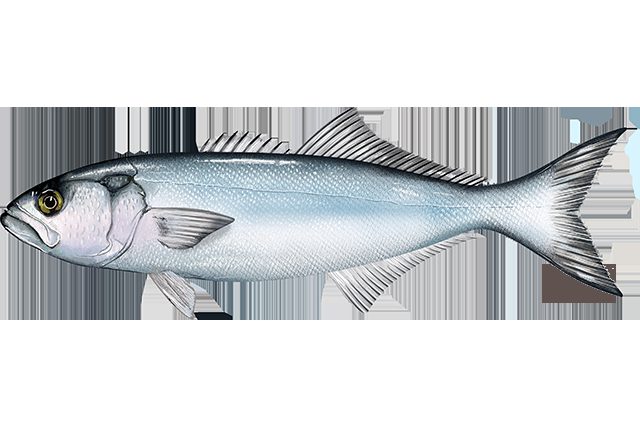
A streamlined, thick-shouldered silver fish with a blue-green back, a large head, a big mouth full of visible, flat, razor-edged teeth, and a projecting lower jaw. Two dorsals: a short spiny one that folds into a groove, and a long soft one. The tail is forked, the pectoral base carries a dark blotch.
At distance it is a fast silver pack near the surface, moving with purpose, often with bait scattering ahead of it and birds above. The teeth and the heavy shoulders separate it from a leerfish or a bonito of the same size.
Juveniles run in dense schools along beaches and in estuaries in summer.
Open coastal water, surf beaches, estuaries, harbour mouths and the water column over rock and sand. It follows bait and moves with it, so it is wherever the sardines, mullet and anchovy are: a beach one day, a point the next.
It hunts near the surface and in the first fifteen metres, in packs that drive bait against the shore or the surface.
Summer and autumn are its seasons on this coast; it moves offshore and south in winter.
The whole Atlantic coast, from Tangier to Dakhla, and the Mediterranean in summer. The Atlantic beaches and river mouths from Rabat to Agadir see the big autumn runs; the south holds fish for longer.
Its biology is well studied in the Americas, Australia and the Mediterranean; not in Morocco. The figures here are a synthesis of those.
Spring and summer, offshore, in the open water over the shelf. The young come inshore in summer and grow fast along beaches and in estuaries.
It matures at two years and grows fast, which is the only reason the species has survived the pressure on it: worldwide the stock is assessed as declining, and the IUCN lists it as Vulnerable.
A pack hunter, fast, aggressive and not particularly wary. A pack driving bait passes a diver at close range and often turns to inspect him. Movement and flash bring it in; a wounded fish brings the pack in harder.
It bites. On the shaft, in the boat, on the stringer: the teeth are sharp and the jaws snap by reflex long after the fish looks dead. Fingers near the mouth of a bluefish get cut.
Big fish are fewer, deeper, and outside the pack.
The species this one is taken for, and what tells them apart.

White seabream
Diplodus sargus

Two-banded seabream
Diplodus vulgaris

Zebra seabream
Diplodus cervinus

European seabass
Dicentrarchus labrax
Apart from the legal size, which comes from the order cited under regulations, this sheet describes the general biology of the species and common practice — not measurements taken on the Moroccan coast. Spawning periods differ from one coast to the other. If you know better, put us right.
Biology FishBase — Pomatomus saltatrix · IUCN Red List — Pomatomus saltatrix · DORIS (FFESSM) — tassergal · Juanes et al. 1996, Marine and Freshwater Research — bluefish biology and fisheries worldwide · read on 14 September 2026